🧾
Scan Anything
Point at a product or a receipt — LENS detects which and scans it the right way.
auto-detectLook at any shelf — LENS instantly understands everything you see.
Live prices · marketplace offers · ratings · AI insights — all in real time.


See it in action
Unedited capture · recorded on lens.amazstock.online
Safe & effortless
Not upload. Not search. Not wait. Live.
① Look
Hold your phone up to a shelf. Recognition frames appear over every product — live, while the camera moves. No photo. No button.
② Know
Every item gets a live market price from your country's marketplaces — and the running total counts itself up in the corner.
③ Decide
The AI layer weighs the shelf price against the live market and returns a verdict — with the confidence to back it up.
 Instant coffee · $8.90 Amazon
Arabica 1kg · $14.20
Espresso · $11.35 · ★4.6
Cold brew · $9.80

For thirty years we carried the world into the internet — photographing, uploading, typing queries. LENS reverses the direction. You look at a thing, and everything the internet knows about it comes to you.
Experience
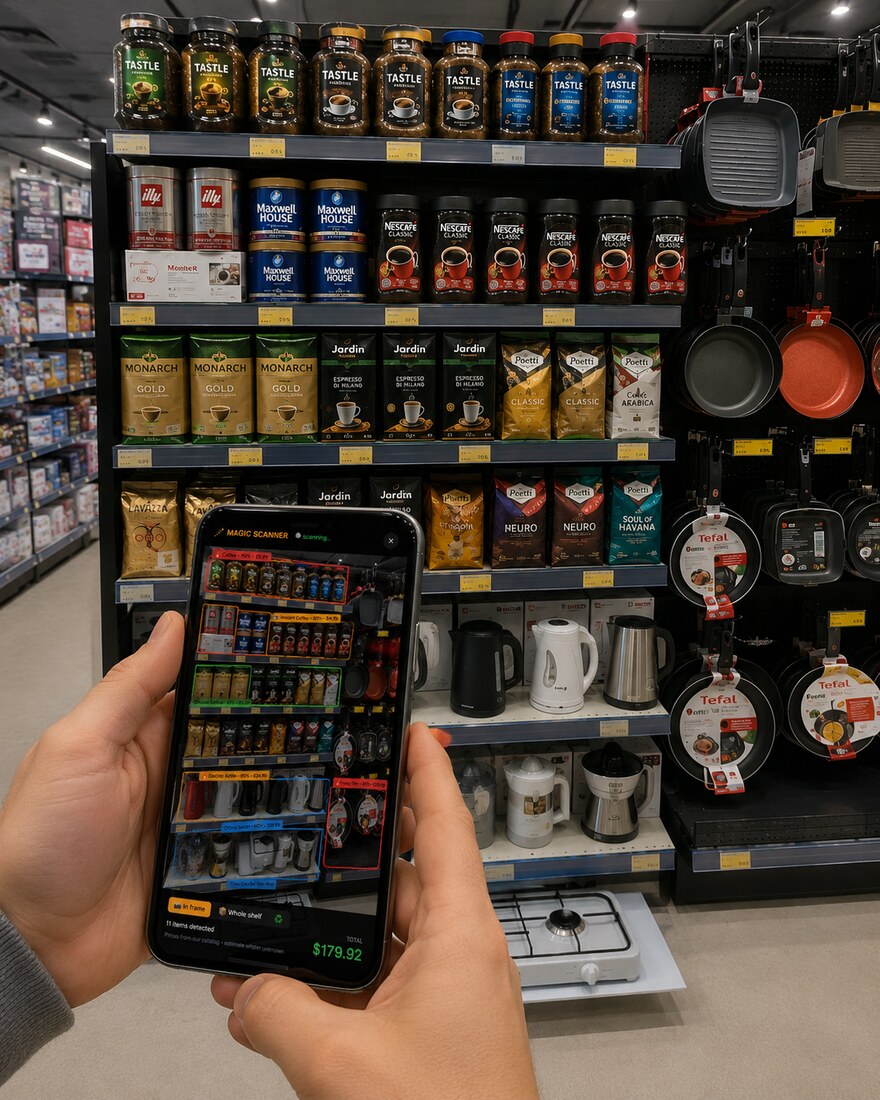 Instant coffee · $8.90 Amazon
★4.6 · 8,214 reviews
Best price nearby · −18%
Similar for less · $6.40
Live
LENS recognizes while you move. The camera and the result are the same moment.Continuous frame analysis — answers on screen in under a second.
Scale
Not one item at a time. LENS reads the entire shelf, the entire pallet, the entire aisle — every product labeled, priced and totaled while you hold the phone.
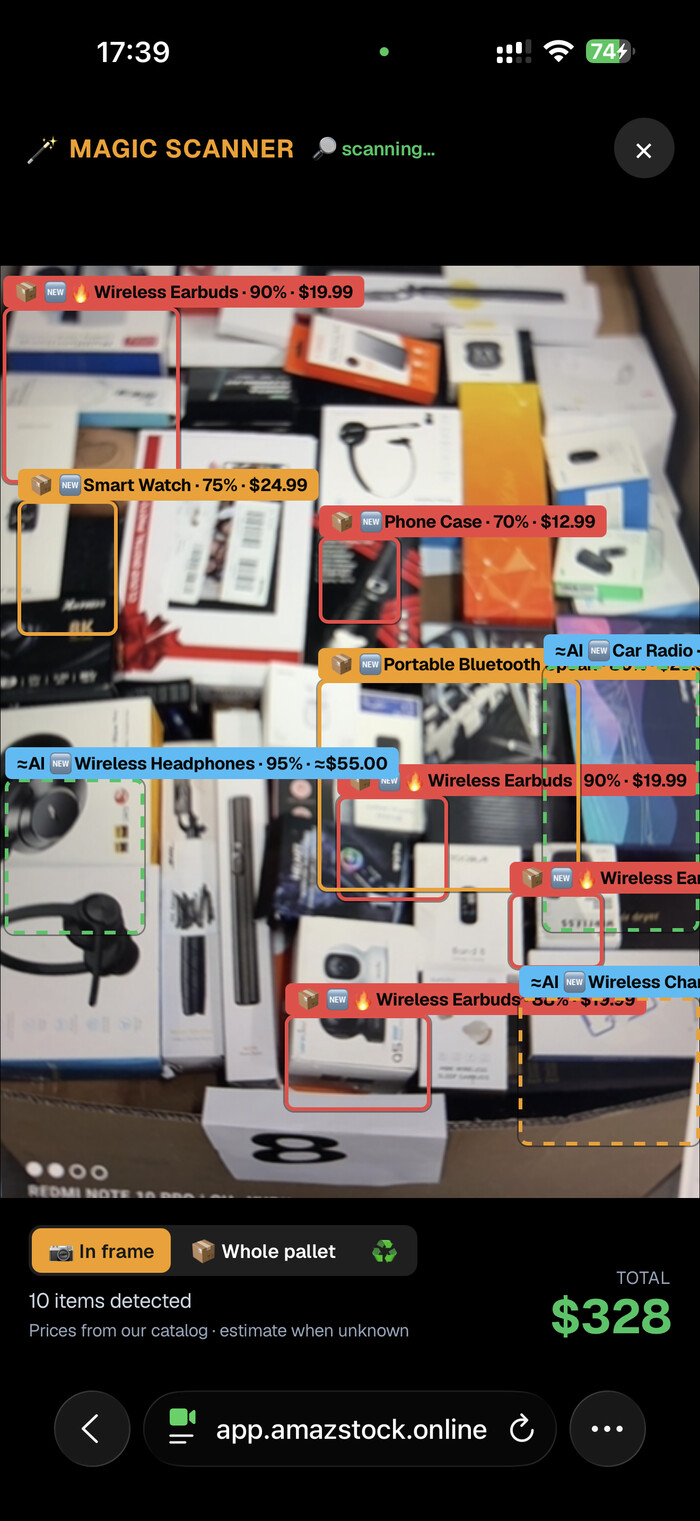
A real scan. A whole pallet, priced in one look.
Global intelligence
No settings. No region switch. 25+ marketplaces · 22 countries — LENS reads where you are and speaks to your local market, in your currency.
Scenarios
AI layer
After LENS sees the product, the AI layer starts working: it doesn't show you data — it tells you what the data means.

Your library
Scans don't disappear. Each one becomes an item in your personal library — ready to compare, track and share.
Before you buy, LENS helps you decide. After you buy, LENS remembers. One camera now understands products, shelves and your receipts — and keeps a living memory of everything you own.
Point at a product or a receipt — LENS detects which and scans it the right way.
auto-detectReceipts sort themselves into your shops — Walmart, Amazon, IKEA — automatically.
zero effortLENS tracks every warranty and reminds you before it runs out.
never miss itGet pinged when something you already own gets cheaper elsewhere.
save later tooReal discounts spotted automatically the moment a product is recognized.
as you scanSee what it's worth in a year — before you ever buy it new.
smart buyingType any price → instant saving, fair value and resale in one tap.
is it worth it?Photos, reviews, price history and a buy-or-wait verdict — filled in for you.
auto-filledYour paper receipts become a searchable memory — warranty, spending by store and one-tap reorders. Open your cabinet →
Tomorrow · Retail platform
Marketplaces were only the beginning. The next layer is the store you're standing in — its own prices, its own stock, its own knowledge, rendered over its own shelves.
You look at a shelf unit. LENS shows the in-store price, availability, aisle & bin, today's discount and the assembly video. Not Amazon — the store itself.
Promotions, loyalty points and coupons appear on the products they belong to — with nutrition, recipes and expiry at a glance.
Point at a fixture and see the screws that fit it, the paint that matches it and the tool that installs it.
Chargers, cases and cables that actually fit this exact model — plus warranty terms before you reach the register.
Own a store or an online shop? Put your data into the layer → Grow with LENS →
Why LENS is different
| Google Lens | ChatGPT | Perplexity | Amazon app | LENS | |
|---|---|---|---|---|---|
| Live camera — no photo, no upload | ~ | — | — | — | ✓ |
| Entire shelf in one frame | — | — | — | — | ✓ |
| Live prices from multiple marketplaces | ~ | — | ~ | one | ✓ |
| Country-aware — local markets, local currency | ~ | — | — | — | ✓ |
| AI verdict: buy, hold or skip | — | ~ | ~ | — | ✓ |
| Price history on the spot | — | — | — | ~ | ✓ |
| Personal library of everything you scanned | — | — | — | ~ | ✓ |
| Works instantly in the browser | app | app | app | app | ✓ |
| Category | AI scanner | AI chat | AI search | Shop app | Visual Commerce Platform |
| Retail & store integration API | — | — | — | — | soon |
✓ full support · ~ partial · — not available. Comparison reflects publicly available features, July 2026.
Roadmap
FAQ
Knowledge
Why streaming frames beats uploading photos — and what changed in 2025 to make it possible on a phone browser.
Classic visual search froze a moment: photo → upload → search. Modern multimodal models are fast enough to annotate a live stream, so recognition became a property of the camera itself. Once results render into the viewfinder, "searching" stops being an action — it's just seeing.
Shopping is moving from typed queries to seen objects. The shelf becomes the search results page.
When any product can be identified in place, the store itself becomes a browsable catalog. Price transparency stops being a website feature and becomes a property of physical space — which changes how stores compete and how people decide.
Every physical item has a data shadow: prices, reviews, history, compatibility. LENS makes it visible.
A digital twin is everything the internet collectively knows about one object — its listings, its reviews, its price curve, its accessories. The twin always existed, scattered. A camera-native layer assembles it and pins it to the object itself.
Foreign shelves, foreign scripts, foreign prices — and one camera that reads them all in your terms.
Abroad, you lose your instincts: brands are unfamiliar and prices are in someone else's currency. LENS localizes the answer instead of the question — it reads the local market and reports back in your currency, with the verdict attached.
The same product can differ 2–3× between markets. How arbitrage hunters and travelers use that gap.
Cross-border price gaps persist because comparing used to be work. When comparison is ambient — one look, every market — the gaps become visible to everyone, and buying where it's cheap stops being a professional skill.
Shelves that explain themselves change what stores optimize for — and reward the honest ones.
When every shopper sees the market price through the shelf, retail shifts from information asymmetry to service, availability and trust. Stores that integrate the layer turn it into their channel; stores that don't are still in it — silently.
Keyboards describe the world. Cameras just point at it. Pointing wins.
Every interface generation removed a translation step: command line → windows → touch. Describing an object in words is the last translation left, and the camera removes it. You don't tell the computer what you see — you show it.
A deal is a price below the market, not below the sticker. How the verdict is computed.
Discount tags compare a price with the seller's own past. LENS compares it with the live market — retail and secondary, local and global — and flags a deal only when the math survives that comparison.
A product feed is enough to make your shelves speak to nearby shoppers. How the partner program works.
Retailers plug in a standard product feed; LENS anchors it to real shelves. Shoppers looking at your products see your price, your stock, your offer — instead of only what the internet says about you.
